



Designing for Building Movement: Rondo’s Approach to Inter-Storey Drift
Rondo internal wall systems are specifically designed and detailed to accommodate horizontal movement of the primary building structure, commonly referred to as inter-storey drift.
This consideration applies both to structural performance and to the potential for building movement to generate noise within internal walls, ceilings and adjoining building elements.
.
What is inter-storey drift?
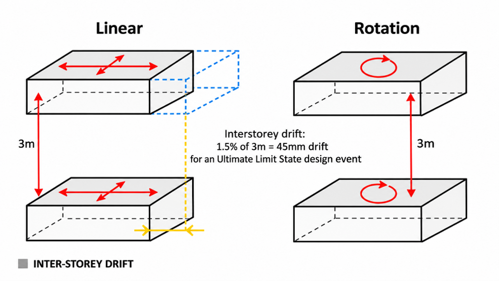
Inter-storey drift is the relative horizontal movement between consecutive floors of a building. As one floor moves relative to another, internal walls and their connections must accommodate that movement.
The extent of movement to be accommodated is not unlimited or arbitrary. It must be quantified for each project by reference to the applicable structural design criteria and the movement information provided by the project structural engineer.
Rondo engineered designs consider both:
1. Ultimate limit state movement, at which the wall system must maintain structural stability and avoid collapse or loss of support; and
2. Serviceability limit state movement, at which the wall system is expected to remain suitable for its intended function, subject to the particular performance requirements of the wall.
Rondo wall systems are not designed on the assumption that the supporting building remains completely stationary. Movement of the primary structure is an established design consideration addressed through the selection and detailing of components such as deflection heads, wall junction detailing, movement joints, isolated interfaces and other project-specific details.
.
What are the compliance requirements for inter-storey drift?
AS 1170.4 requires non-structural parts and components, including internal non-loadbearing walls, to accommodate the applicable design inter-storey drift. The Standard also establishes an ultimate limit state inter-storey drift criterion of up to 1.5% of storey height in the relevant circumstances.
.
What testing has Rondo completed on inter-storey drift?
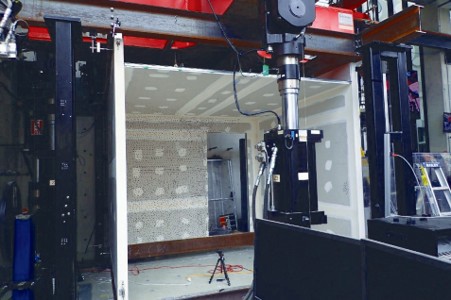
Rondo has undertaken full-scale testing of wall and ceiling systems at Swinburne University of Technology. The testing included imposed lateral movements representative of building inter-storey drift. The testing demonstrated that appropriately detailed Rondo systems:
• accommodated serviceability-level drift without damage in the tested configurations; and
• continued to maintain stability and resist total structural failure at movements extending to and beyond the ultimate drift criterion, notwithstanding localised damage at very high movement levels
.
Swinbourne University Laboratory Testing
The results and associated detailing recommendations are documented in Rondo’s published technical literature: The Professional Series – Series Q1, Rondo QUANTRO Pro Isolation Solution
In addition to damage and structural performance, Rondo’s testing also examined the relationship between building movement and noise generation. The testing identified that movement-induced noise may occur where parts of the internal framing system, linings or adjoining building elements are restrained against moving in a flexibly restrained manner, resulting in friction, binding, metal-on-metal contact or the transfer of movement between elements that would otherwise move independently.
Testing showed that the relative movement and force transfer between the primary structure and the internal framing system can be reduced through appropriate detailing. By introducing flexibility, clearances, isolation and independent movement at critical interfaces, the potential for frictional resistance and associated noise generation can also be reduced.
.
How was test data used to develop the Rondo Quantro Pro Isolation Solution?
Rondo test findings form part of the technical basis for the Rondo Quantro Pro Isolation Solution. In the context of building movement-induced noise, Rondo considers the expected horizontal movement of the building and applies the relevant Quantro Pro principles to the project, including project-specific detailing intended to minimise unintended restraint and relative movement at critical junctions.
It is important to distinguish between:
• accommodation of structural movement;
• cosmetic damage to finishes;
• loss of serviceability;
• noise generation; and
• structural failure.
The occurrence of cracking, localised lining damage or noise does not, by itself, establish that the wall framing system was not designed to accommodate building movement. These outcomes may be influenced by the magnitude and frequency of movement, interfaces with adjoining building elements, lining and jointing details, workmanship, installation tolerances, services, finishes and whether the actual project movement was consistent with the design information provided.
Rondo systems expressly account for quantified building movement, provided that the relevant movement criteria are communicated, the appropriate system and details are selected, and the system is installed in accordance with the project design and Rondo requirements.
.
What approach does Rondo take in addressing building movement through engineered design?
Rondo internal wall systems consider horizontal building movement as inter-storey drift is an explicit design consideration addressed through Rondo’s engineering methodology, system detailing, published guidance and physical testing. This includes consideration of both structural and serviceability performance and the use of project-specific detailing to reduce unintended restraint, relative movement and the potential for building movement-induced noise.
While the Rondo QU01 Isolation Clip is one proprietary component that may be used as part of the Quantro Pro Isolation Solution. It is not, by itself, the entirety of the solution.
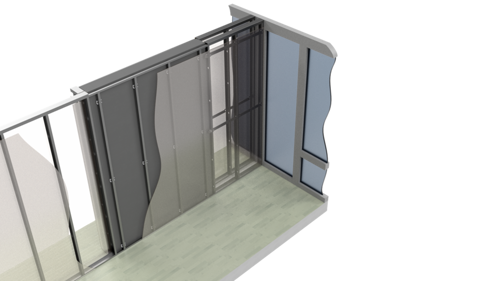
QUANTRO® Pro Isolation Solution
The Rondo Quantro Pro Isolation Solution is a broader, project-specific approach developed to reduce the risk of movement-induced noise and related performance issues in internal wall and ceiling systems. It combines:
• proprietary Rondo components, including the QU01 Isolation Clip where appropriate
• project-specific engineering assessment
• interface and junction detailing
• consideration of the expected building movements
• coordination between framing, linings, structure, services and other adjoining elements
• installation guidance and education, and
• ongoing technical support during design and construction.
The QU01 Isolation Clip addresses a particular movement transfer mechanism. In some building configurations, furring channels are directly fixed to structural columns or other primary structural elements and are then connected through continuous linings or adjoining details to stud walls. Movement of the primary structure can consequently be transferred into the adjoining wall and lining system, potentially producing restraint, stress accumulation, friction or noise.
QU01 Isolation Clip
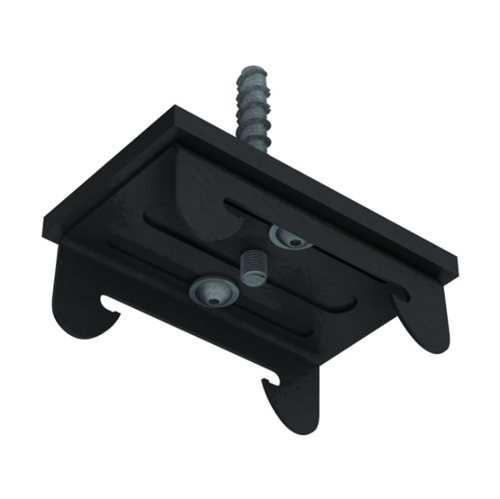
The QU01 clip is designed to provide in-plane isolation between the moving structure and the furring channel system while continuing to provide the necessary out-of-plane restraint for the relevant design actions. Its function is therefore very different from that of a conventional rigid furring channel connection.
However, building movement-induced noise is not caused by one universal mechanism. Potential contributors may include:
• wall-to-column interfaces
• wall intersections
• ceiling and bulkhead junctions
• continuous linings spanning between elements that move differently
• services and penetrations
• façade and perimeter interfaces
• fixings and fasteners, and
• the magnitude, frequency and direction of actual building movement.
For this reason, the Rondo Quantro Pro Isolation Solution is deliberately structured as a holistic solution involving products, engineering, detailing, coordination and construction support.
Rondo internal wall systems are specifically designed and detailed to accommodate horizontal movement of the primary building structure, commonly referred to as inter-storey drift. This consideration applies both to structural performance and to the potential for building movement to generate noise within internal walls, ceilings and adjoining building elements.